
An astrological perspective on eclipses
We will be entering into “eclipse season” soon, with eclipses happening on the following dates:
- 18 Sep 2024 – Partial lunar eclipse
- 2 Oct 2024 – Solar eclipse
This is part two of a two-part series on eclipses. In part one here, I gave an astronomical perspective on eclipses, sharing how they come about in the sky.
In this second post, I will share from an astrological perspective, talking about the significance of eclipses in astrology, what to do and what not to do during eclipse season.
How do we see eclipses in an astrological chart?
Lunar Nodes

At the end of the previous post, we end off by clarifying that eclipses can only happen when the dark or full moon occurs near or right on the plane of the Earth’s orbit (red dot in diagram above).
The points on the Moon’s orbit when the Moon is aligned with the Earth and Sun are known as the lunar nodes. There are two such nodes, one opposite the other, on the Moon’s orbit.
The node where the Moon moves from below to above (or south to north) is known as the north node, and the opposite node where the Moon moves from above to below(north to south) is known as the south node.
In vedic astrology, the north node is also referred to as Rahu while the south node is referred to as Ketu.
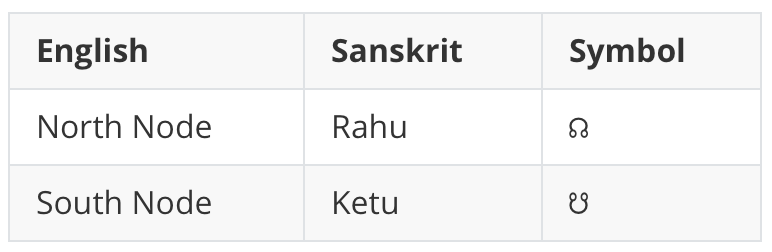
Circular Charts – Western Astrology

The chart above is for the upcoming lunar eclipse taking place on 18th September 2024 at about 11:20am SGT. Several points to highlight here:
- This chart is for the moment where full moon takes place, as shown by the Sun and Moon being directly opposite each other.
- Both the Sun and Moon are somewhat close to the nodes, giving rise an eclipse. However, they are still some distance away from the nodes, about 11°, therefore this will only give a partial eclipse, and not a total eclipse.
- The closer the dark or full moon is to the nodes, the more complete the eclipse will be.
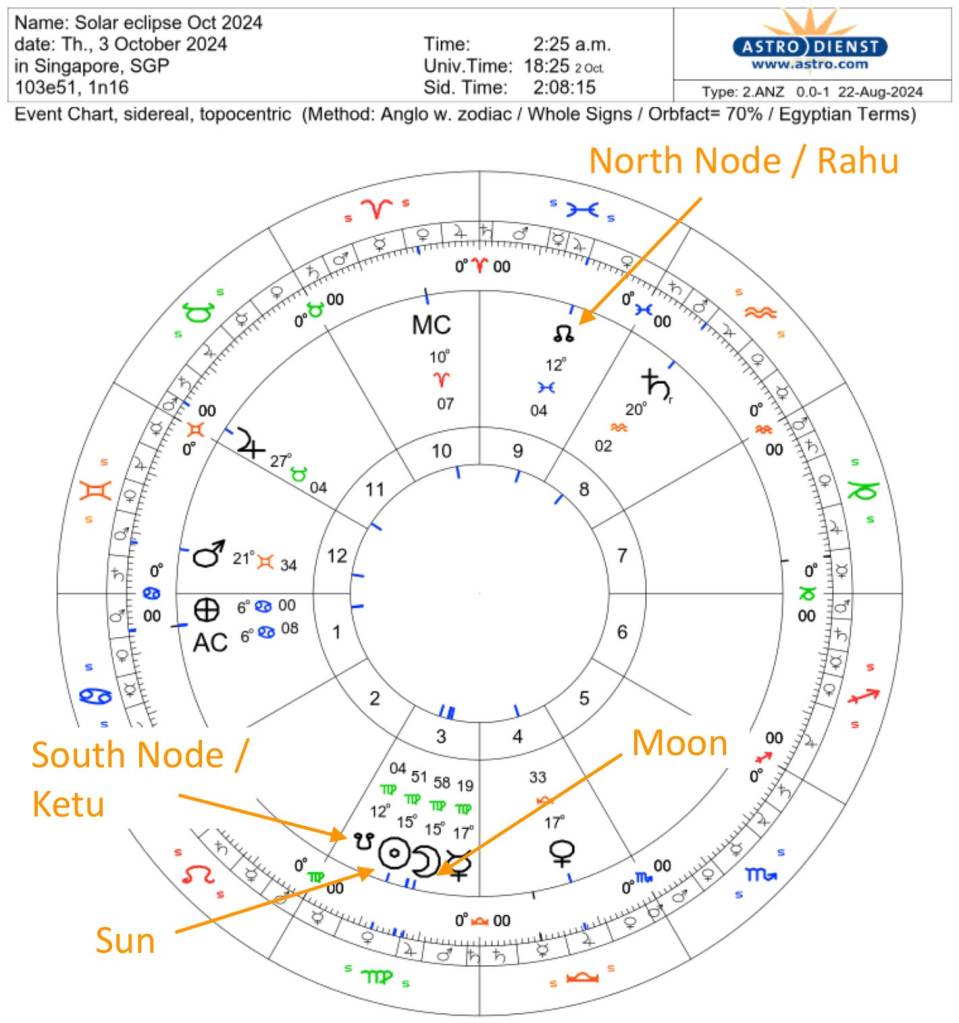
The chart above shows the solar eclipse taking place on 3rd October 2024 at about 02:25am SGT. Here, the dark moon (shown by the Moon and Sun together) takes place much closer to the nodes, within 4°, giving rise to an annular solar eclipse where the Sun is close to being completely blocked by the Moon.
Square charts – Vedic Astrology
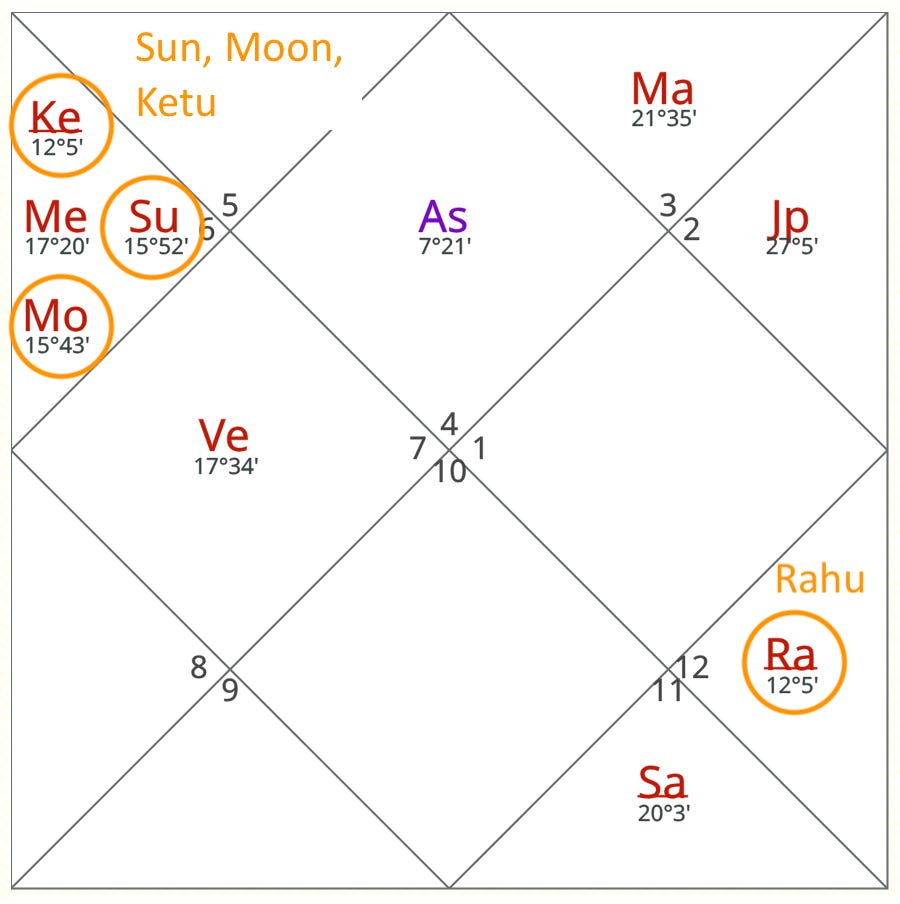
Below I have reproduce the same charts of the eclipses, but presented them in a square chart format that is commonly used in vedic astrology. Historically, square charts were more common due to the ease of drawing them.
The other key difference here is the use of abbreviations of the planets’ name in the chart, as compared to the use of the planets’ symbols in the circular chart above.
What’s show here is one particular form of the square chart, also known as the North Indian chart, popular within the north parts of India. The East and South parts of India have their own ways of drawing the square charts, but are not shown here.

Astrological significance of eclipses
In general, eclipses are ill omens. Eclipses indicate the “covering” or “disappearance” of the Sun or the Moon, their light being covered by shadow.
The Sun represents truth and dharma, and is also the giver of life. During a solar eclipse, truth and dharma gets covered up. It becomes difficult to see things clearly, or perhaps truth is being hidden from us. The absence of Sun’s light can also indicate difficulty in starting something(e.g. a project or a job), since the life-giver has disappeared.
The Moon represents our mind and the sustenance of life (the Sun starts and the Moon sustains). During a lunar eclipse, our mental faculties gets obscured and becomes difficult to think clearly. We may end up questioning the decisions we made during the eclipse season. Projects started during eclipses, even if they may get off to a seemingly good start, the absence of the Moon can make it difficult to see it through.
What to watch out for during eclipse season
There are differing opinions on when an eclipse season start and end. There are usually 2-3 eclipses per season, sometimes 4. I usually consider the season to start about 1 week prior to the first eclipse, and end 1 week after the last eclipse.
What not to do
- Do not make any major decisions
- Do not start a new project / business, sign any contract etc. If you really have to, go over the plan with someone you can trust to catch any flaws or potential problems. But really, don’t.
- You may find yourself getting into arguments or conflicts, especially with your loved ones. As soon as you regain awareness around what’s happening, take a step back and breathe. You may find that you were arguing over something very insignificant. Let it go.
- Don’t break up with your partner (see points 1 and 3 above).
What is good to do
My guru advocates spiritual practices to be done, especially during the actual day(s) of the eclipses. These can include meditation, fasting, mantra recitation (mantra japa), watching of the breath, or any practice that helps to ground and purify your energies. It is also good to start off the session with a practice that offers protection from the negative energies of the eclipse, such as the mantra of Sri Narasimha.
On a similar vein, you may wish to be more careful and discerning about the energies around you, be it the people you hang out with, or the places you visit. Eclipses are sensitive times.
I hope this has been helpful for you. If you want to know more about astrology or get an astrology reading, head on over to this page.

 Jerry Astrology
Leave a comment