Jupiter just entered sidereal Cancer, its sign of exaltation. This is a transit that occurs only once every 12 years. Jupiter will stay in sidereal Cancer until the end of next June, though there will be a brief period where it moves into sidereal Leo before retrograding back into Cancer. The specific dates are as follows:
- Cancer: 2 Jun – 31 Oct
- Leo: 31 Oct – 25 Jan 2027
- Cancer: 25 Jan 2027 – 26 June 2027
Towards the end of last year, Jupiter made a very brief entry into Cancer, from 18 October to 6 December. At that time, I had written a blog post here sharing the significations of Jupiter and its state while in Cancer. I also gave some examples describing the effects of Jupiter across different houses in a natal chart.
Back then, I also suggested that we pay close attention to what happened during that timeframe, especially events corresponding to Jupiter’s significations. This is because what happened during that period serves as a sneak preview for what’s to come now that Jupiter is entering Cancer again. You might want to look back and recall what Jupiter-related experiences you had between 18 October to 6 December of last year. Please feel free to share them in the comments section below.
Guṇa – State of Being
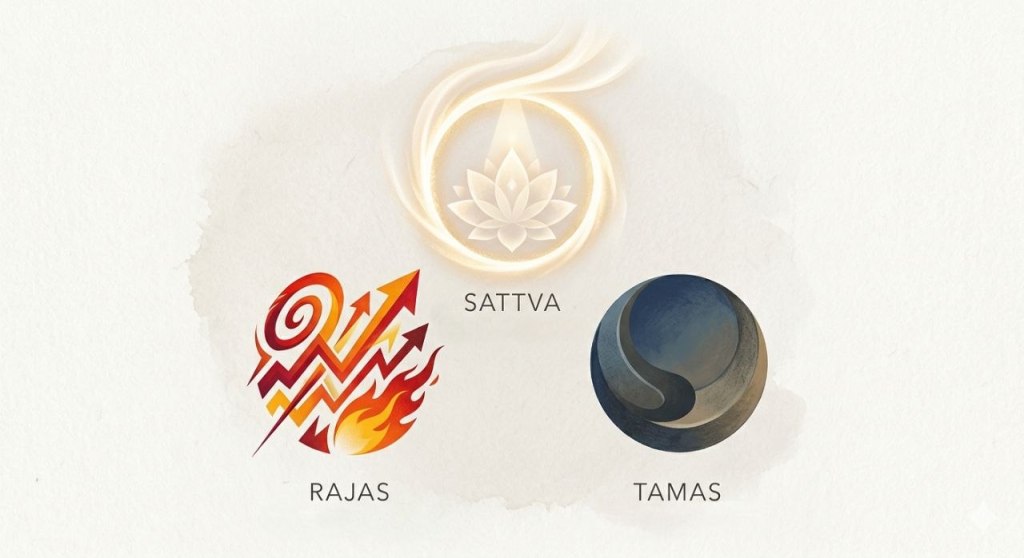
Today, I wish to approach and share about Jupiter from the perspective of guṇa. Guṇa refers to the “state of being”. There are three types of guṇa – rajas, tamas, and sattva. In very simplistic terms, they can be understood as “too much, too little, and just right” respectively.
Rajas guṇa is the state that corresponds to creation. Having an excess of energy and also desire, and as a result bring forth something, or someone, into being. Rajas guṇa also corresponds to passion, greed and craving.
Tamas guṇa is on the opposite end to rajas guṇa. It is the state that corresponds to destruction. A lack of attention, negligence and laziness that resulted in things falling apart and breaking. Tamas guṇa also corresponds to ignorance and so-called “sleep-walking”, failing to notice what’s present and happening right at this moment.
Sattva guṇa lies in the middle between rajas and tamas. It is the state of balance between the two extremes. It is the state of taking action with clarity and awareness. In this state, a person does things that needed to be done, but without attachment, and without desire for some particular outcome. Sattva may perhaps be described as being in the state of “flow”, being completely present, aware and appreciative of everything that’s happening right at this moment, taking whatever actions that are called for, without wanting it to last forever, nor wanting it to be some other way.
The Bhagavad Gita chapters 14, 17 and 18 describes guṇa in much greater detail. Here, we will look at several paragraphs from chapters 17 and 18 to help give a better understanding of these 3 guṇas.
Chapter 17, Verses 20–22:
Charity given to a worthy person simply because it is right to give, without consideration of anything in return, at the proper time and in the proper place, is stated to be in the mode of goodness. (sattva).” (17.20)
But charity given with reluctance, with the hope of a return or in expectation of a reward, is said to be in the mode of passion (rajas).” (17.21)
And that charity, which is given at the wrong place and wrong time to unworthy persons, without showing respect, or with contempt, is held to be of in the mode of ignorance (tamas).” (17.22)
Chapter 18, Verses 23 – 25:
“Action that is in accordance with the scriptures, free from attachment and aversion, and done without desire for rewards, is in the mode of goodness. (sattva).” (18.23)
“Action that is prompted by selfish desire, enacted with pride, and full of stress, is in the nature of passion (rajas).” (18.24)
“That action that begun out of delusion, without thought to one’s own ability, and disregarding consequences, loss, and injury to others, is in the nature of ignorance (tamas).” (18.25)
Chapter 18, Verses 26 – 28:
“A person who is free from attachment and ego, endowed with fortitude and enthusiasm, and unperturbed by success or failure, is called a person of goodness (sattva).” (18.26)
“One who desires the fruits of labor, is greedy, violent, impure, and easily swayed by joy and sorrow, is called a person of passion (rajas).” (18.27)
“One who is undisciplined, vulgar, stubborn, wicked, malicious, lazy, depressed, and procrastinating, is called a person of ignorance (tamas).” (18.28)
Now that we have a better understanding of the guṇas, let’s come back to our main focus of this post, Jupiter transiting through sidereal Cancer.
Cultivating Sattva
In the Brihat Parashara Hora Shastra (BPHS), Rishi Parashara introduces the guṇa of each planet, and describes Jupiter guṇa to be that of sattva. In addition to that, any planet that is in its sign of exaltation, Cancer in the case of Jupiter, is also said to be in the state of sattva.
Therefore, Jupiter’s transit through Cancer, between now and June of 2027, is a period when sattva is highly elevated, and is a wonderful period for all of us to cultivate more sattva in our own lives.
May we live each and every moment with great presence, noticing and appreciating everything as it is, without wanting it to be any different nor lasting forever.
May our lives be more balanced and peaceful.
Om Gurave Namah.

 Jerry Astrology
Leave a comment